
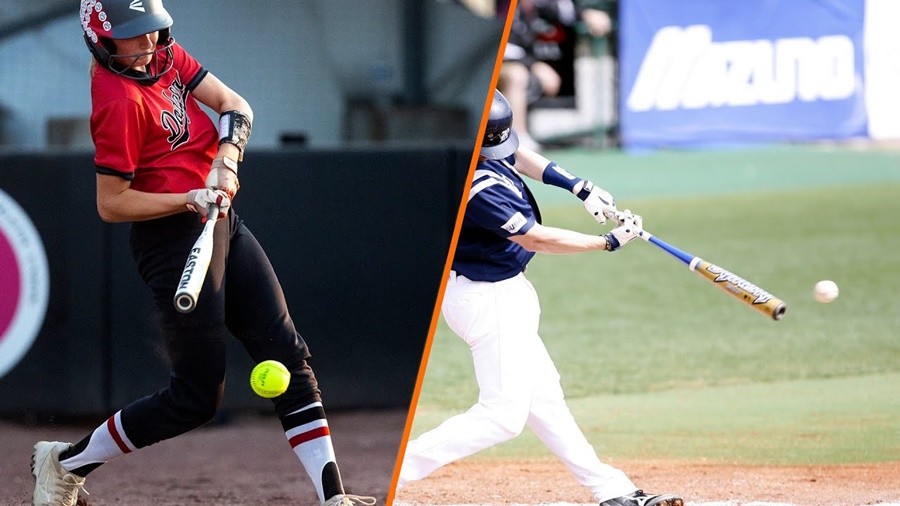
Although baseball and softball look similar at first glance, the equipment used in each sport especially the bats differs in important ways. These differences are not just about size; they affect performance, safety, and compliance with league rules. This article explains the key differences between baseball and softball bats in detail, helping players, parents, and fans understand why the two are not interchangeable.
Overview of Baseball and Softball Bats
Both baseball and softball bats are designed to hit a pitched ball, but they are engineered specifically for the size, weight, and speed of the ball used in each sport. Baseball bats are built to hit a smaller, harder baseball, while softball bats are optimized for a larger, heavier softball that is often pitched underhand.
Using the wrong bat for the sport can reduce performance and may even be illegal in organized play.
Bat Length
One of the most noticeable differences is length.
- Baseball bats typically range from 24 to 34 inches, with adult bats usually between 31 and 34 inches.
- Softball bats generally range from 26 to 34 inches, though many fastpitch softball bats fall between 28 and 34 inches.
While the maximum length is similar, softball players often choose slightly longer bats to help cover the larger strike zone.
Bat Weight and Drop Weight
Weight Differences
Bat weight is crucial because it affects swing speed and control.
- Baseball bats are usually heavier relative to their length.
- Softball bats tend to be lighter, allowing for faster swings.
Drop Weight Explained
Drop weight is the difference between the bat’s length (in inches) and its weight (in ounces).
- Baseball bats commonly have drop weights like -3, -5, or -8, depending on age and league.
- Softball bats often range from -8 to -13, especially in fastpitch softball.
A higher negative drop weight means a lighter bat, which is more common in softball.
Barrel Diameter
The barrel is the thickest part of the bat and one of the most important distinctions.
- Baseball bat barrel diameter is typically 2 5/8 inches or 2 3/4 inches, depending on league rules.
- Softball bat barrel diameter is usually 2 1/4 inches, 2 1/2 inches, or 2 3/4 inches.
Softball bats often have larger barrels to increase the “sweet spot,” making it easier to hit the larger softball solidly.
Bat Material
Both baseball and softball bats are made from similar materials, but their construction differs.
Baseball Bat Materials
- Wood (maple, ash, birch) – common in professional baseball
- Aluminum
- Composite
Softball Bat Materials
- Aluminum
- Composite (very common in fastpitch softball)
Wood bats are rare in softball, while they remain standard at higher levels of baseball.
Design and Performance Differences
Baseball Bat Design
Baseball bats are designed to:
- Handle higher pitch speeds
- Hit a smaller, denser ball
- Emphasize precision and power
Softball Bat Design
Softball bats are designed to:
- Maximize trampoline effect for a larger ball
- Provide a bigger sweet spot
- Support faster swing speeds
Composite softball bats, in particular, are engineered to flex more on contact, boosting performance.
Grip and Handle
- Baseball bats often have thicker handles for better control when hitting high-velocity pitches.
- Softball bats usually feature thinner handles with added grip tape or cushioning to improve wrist action and bat speed.
These differences support the distinct hitting mechanics used in each sport.
Certification and League Regulations
Both sports have strict rules governing bat use.
Baseball Bat Certifications
Common standards include:
- BBCOR (for high school and college)
- USA Baseball
- USSSA Baseball
Softball Bat Certifications
Common standards include:
- USA Softball (ASA)
- USSSA Softball
- NSA, ISA, and others
A bat approved for baseball is not automatically legal for softball, and vice versa.
Can You Use a Baseball Bat for Softball (or the Opposite)?
Using the wrong bat is strongly discouraged.
- A baseball bat used for softball may perform poorly and could be damaged.
- A softball bat used for baseball is unsafe and often illegal due to performance differences.
Additionally, using the wrong bat in a game can result in penalties or disqualification.
Summary of Key Differences
| Feature | Baseball Bat | Softball Bat |
|---|---|---|
| Ball Size | Smaller, harder | Larger, softer |
| Typical Length | 24–34 inches | 26–34 inches |
| Weight | Heavier | Lighter |
| Drop Weight | Usually -3 to -8 | Usually -8 to -13 |
| Barrel Diameter | Up to 2 3/4 inches | Up to 2 3/4 inches |
| Materials | Wood, aluminum, composite | Aluminum, composite |
| League Standards | BBCOR, USA, USSSA | USA Softball, USSSA |
Conclusion
While baseball and softball bats may look similar, they are built for different purposes. Differences in length, weight, barrel size, materials, and certification standards all play a role in optimizing performance and ensuring safety. Choosing the correct bat for the sport is essential for success, comfort, and compliance with the rules.
Understanding these distinctions helps players make informed decisions and perform at their best whether stepping up to the plate in baseball or softball.
Leave a Reply